Charlotte Wolff - Chirological
Scientist
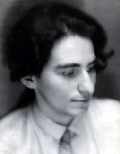
Charlotte Wolff (1897-1986) is the one chirological researcher who has
conducted complete studies on the hands of the mentally retarded and the mentally
diseased. As a qualified physician and a psycho-analyst, she stands as one of the very few
scientifically trained people ever to have seriously investigated the diagnostic
significance of the hand. Moreover, she stands as one of the very few people to have
conducted substantial empirical research into the patterns of the hands which, as a
result, have given chirological diagnosis a sure and certain scientific basis.
Charlotte Wolff grew up in Danzig and studied medicine and philosophy
at Konigsberg, Freiberg and Berlin universities, qualifying as a doctor after her
probationary year in 1925. She set up in medical practice in Berlin and became interested
in chirology in 1931 after a friend of hers had had her hands read by Julius Spier. She
too had her hands read and was so impressed, she immediately enrolled on a course he was
teaching to physicians. Her qualifications as a doctor enabled her to actively pursue her
medical researches into the hand right from the start, and so began a twenty year period
of single-handed research into the medical and psychological significance of the hand.
However, she was not to stay in Germany. She escaped Germany for France
in 1933 after having been first harassed and then arrested by the Gestapo on account of
her Jewish extraction. But this manifest misfortune was to turn out to be of utmost
importance for her chirological career. As an exile in Paris, her medical qualifications
were of no account; she was not allowed to practice medicine and was therefore forced to
fall back on other skills in order to earn a living. She turned, almost reluctantly, back
to chirology.
Through the good fortune of well connected friends, she was soon to
meet Thomas Mann and Aldous Huxley and subsequently came to know many of those in the
literary and artistic circles of the day. Huxley introduced her to the Surrealist clique
in Paris and later invited her to stay in London, where he introduced her to the London
literary set and promised her that he would write the preface for her first book. He had
written to his publishers and suggested the idea of a book of handprints of well-known
people with short interpretations of their hands. 'Studies in Handreading' was
then published in 1936. The book itself gives only a brief exposition of Charlotte Wolff's
chirological methodology; it is most noteworthy for the collection of famous handprints
that it contains, including the prints of Marcel Duchamp, Max Ernst, Man Ray, Ravel, TS
Eliot, Virginia Woolf, George Bernard Shaw, and Aldous Huxley himself. She also presents
the prints of a comparative study of the hands of 'materialists' and 'spiritualists', to
demonstrate how different orientations in life produce radically different chirological
features.
Up to this point, her work was much more psychoanalytical than
psychological. She had been undergoing Jungian analysis in Germany and Paris, though later
became more impressed by the writings of Freud and the neo-Freudians, and her first book
shows rather more psychoanalytical and palmistic influences than her later works. Her more
serious research into the psychological significance of the hand began in Paris through
the permission and influence of the eminent French psychiatrist Professor Henri Wallon,
who enabled her to begin her research in the hospitals and clinics of Paris and so enable
her to commence her studies into mental defectiveness and endocrinological imbalance as
manifested in the hand.
When in London, Aldous Huxley introduced her to his brother Julian
Huxley, the then secretary of the Royal Zoological Society, and he gave her permission to
take the handprints of the apes at London Zoo for her comparative studies of the hands of
apes and humans. She also got to know Dr William Stephenson of University College London
and he was able to provide her with research facilities and access to mental colonies and
hospitals for her to continue her researches into mental illness and the hand. And through
all this time, she was working as a handreader to earn her daily living, though she rather
tired of this and considered it only a secondary task to her main aim of presenting
psychological chirology on a secure scientific basis. Her investigations into the abnormal
psychology of the hand was founded on the basic axiom of psychologyas a science that it is
the study of the abnormal that provides the best evidence for the nature of the normal.
She wrote two books to outline the scientific basis for her chirology, 'The
Human Hand', published in 1942, and 'The Hand in Psychological Diagnosis' published
in 1951. In these works, she only really acknowledges the writings of Carus and Vaschide
as the important precedents to her approach to chirology, although she also refers to the
neurological work of Sir Charles Bell and the clinical writings on nails of H Mangin and V
Pardo-Castello. Her books are full of statistics and charts and her language can be a
little technical and jargonistic at times, all attempts to persuade her audience of the
scientific seriousness of her approach and her total disassociation with any kind of
'palmistry'. However, whilst she denounces palmistry, she has obviously read at least
D'Arpentigny and Desbarolles and indeed, has listened to some of the basic palmistic
claims; for her researches have validated a considerable number of the basic chirological
assertions and assumptions.
For instance, she has statistically verified the association of each
half of the palm with the 'conscious' and 'subconscious' mind and confirmed that the
fingers are indeed related to both cognition and thought. She affirmed that the index
finger and the thumb are indicative of self-consciousness and willpower respectively and
that the Major Air line is indeed one of the most important indicators of mental
functioning. She demonstrated how the lines of the hand are more reflections of mental and
emotional activity rather than being caused by any mechanical means and she also
established that various medical conditions do indeed manifest in the hand. Her
investigations of gross endocrinological dysfunctions showed how the hand could reveal
both physiological and psychological disorders.
Her other researches revealed that the hand can be successfully
employed in the assessment of schizophrenics, manic depressives, imbeciles, mental
defectives and congenital idiots and she reproduces many handprints in her texts to
illustrate her findings. Her main chirological contributions therefore are to the fields
of endocrinology, mental defectiveness and mental health and how these can be detected
from the hand.
In addition to her two strictly scientific works, she also contributed
several articles to the British Journal of Medical Psychology (1941 & 1944)
and the Journal of Mental Science (1941), wherein she published the results of
her researches into the hands of the mental defective, and the Proceedings of the
Zoological Society (1937 & 1938), where she published the results of her
comparative studies of the hands of apes.
A fourth book 'The Psychology of Gesture' published in 1945,
was more of an ancilliary study to her main researches, studying the hands of both
'normal' people and those with mental illness to establish the significance of hand
gestures. She nevertheless considered it an important study for giving further empirical
support for the study of the hands as a means of gauging character and temperament, for it
further demonstrated how the hands are so closely connected to internal emotional and
psychological states.
In all, she has contributed considerably to the development of
scientific chirology and has provided much in the way of sound argumentation for the
physiological and psychological basis for the study of the hand. She views the hand as the
visible part of the brain and considers that handreading could have a revolutionary impact
on the whole study of psychology. She even goes so far as to say that she believes the
hand to be a far more reliable means of gauging temperament, character, intelligence and
mental functioning than any other psychological test available in her day, a fact that
remains true even now.