Chiromancy, Fatalism and Prediction
In comparing these three texts together then, we can see some
considerable agreements amongst them in their attitudes and orientation that gives us a
pretty fair idea of the state of the art of handreading at that time. What is also
interesting to consider here is how much of fifteenth century chiromancy has percolated
down through the centuries. For from these texts we can see why there is the commonly held
belief that palmistry is all to do with fortune telling and predicting marriages, numbers
of children and death.
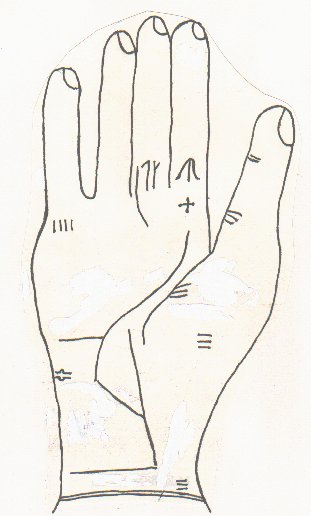
What is particularly evident is how much of contemporary palmistry
still uses these outmoded interpretations! The associations made for the Apollo line and
for the affection lines are still thought of as important indicators of fame and marriage
even today. But it is quite clear that the use of certain of the signs and marks, in
particular symbols such as the Triangle and the Quadrangle, are really only relevant only
to the mind set and mentality of the fifteenth century.
The emphasis in chiromancy at that time is markedly oriented towards a
consideration of the hand in terms of signs of one's fate and fortune. In the kind of
fixed society that was feudalism, such a fatalistic attitude is really to be expected.
Life ran to a predetermined pattern and you remained within the social class to which you
were born. There was very little opportunity for social mobility or for bettering your lot
- if you were born a serf you stayed a serf. Furthermore, the predetermination that was
apparent in daily life was equally reflected in the philosophy of predestination that
prevailed in the thinking of the Church. Given these facts of fifteenth century life, it
really is no surprise that the chiromancy of the day was preoccupied with predicting one's
fate and destiny.
It is obvious then that much of this early chiromancy is of very little
practical use or relevance for people today, and so it is surprising to see how many of
the signs and symbols used then are still used in contemporary palmistry! From
reviewing such texts as these, we can see how inappropriate it is to unquestioningly
utilise mediaeval traditions of handreading in modern times and that it is really quite
naive to continue to interpret the lines of the hands simply as signs and portents of
one's 'fate'. Telling fortunes and making predictions is exactly what the fifteenth
century chiromancer was interested in doing and, given the social, economic and political
context of fifteenth century society, this is hardly surprising. To expect this of
handreading was entirely correct five hundred years ago. But to think of modern hand
analysis in this way is about as accurate as expecting your local GP to treat you with
leeches! (*) To call a modern doctor a leechman is to ignore all the
developments of medical science of the last five hundred years. Equally, to think of a
contemporary hand analyst as a mere 'fortune teller' is also to be some five hundred years
out of date....
Back to Top


(*) This is not actually an invalid comparison to make here, for
in the fifteenth century the ring finger was often referred to as the leech finger (or the
medicine finger in the Latin texts). This accurately reflects the nature of medical
practice at that time, since leeches were thought to be a beneficial means of draining and
cleansing the blood and hence to be a valuable treatment for curing infections.
Interestingly, they were put on the ring finger because it was thought that this finger
had a special connection with the heart - hence the tradition of wearing the marriage ring
on this finger.