
|
|
|
|
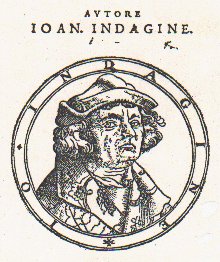
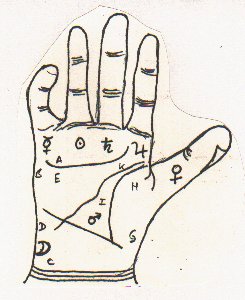
Introductiones Apotelesmaticae In the epistle to the reader which prefaces the chiromancy, Indagine entreats us not to prejudge the art of chiromancy until we have read through this work. He has read the ancients and asserts that Socrates, Aristotle and Pliny found favour with the art, quoting the latters' comment that the length of the lines can reveal the length of one's life. He tells us that the hand is a means '...whereby to discern and know the inward motions and affections of the mind and heart, the inward state of the whole body and also our inclination and aptness for all our external actions and doings' and is thereby an important tool for our own selfknowledge and self-understanding. However, he advises us that we should use chiromancy, physiognomy and astrology all together if we are to get a full appreciation of a persons natural inclinations. Indagine puts particular emphasis on the use of astrological symbolism in both the chiromancy and his physiognomy and at various points in the treatise gives descriptions of physiognomical archetypes according to the astrological signs. He often breaks off his discussion of the lines to give correlations between disease conditions and the seven planets or the four humours. The chiromancy itself begins with a description of the parts of the hand, the palm, the thumb and the fingers (the little finger is called the 'ear' finger we are told '...because it is commonly used to make clean the ears'!), the wrist and the mounts, with their astrological rulers, and finally the lines. The second chapter deals with the line of life, with a quick diversion into the general significance of each of the seven major planets together with some observations on each of the signs of the zodiac. Indagine confirms the meaning of a circle on the lifeline as an indicator of loss of one's sight, for he tells us that this misfortune actually befell him one winter, when he fell into a fire and lost his left eye!
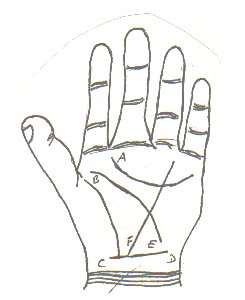
The next chapter deals with the wrist and the rascettes, which are seen as important indicators of fortune or misfortune, depending on how well they are formed, whilst the sixth chapter deals with the triangle. We still find this to be considered an important chiromantical indication, for a well-formed triangle '... being of equal angles, having lines fair, wellcoloured and straight does represent the good qualities of nature and of the body, with health and security of the mind, with fame and renown and also long life'. Markings within the triangle are also considered, the most ominous of which Indagine finds to be the star; in men this shows an untruthful, deceitful slanderous person who is also a violent thief and a robber, whereas in a woman's hand such a star would show an unchaste and adulterous woman given to such irrestrainable anger and madness of mind that she will cut her own throat! The quadrangle, formed by the Natural line and the Table line, and the markings that can be found within it are dealt with in the next chapter. A good space in the quadrangle shows a liberality and stoutness of stomach whereas a narrow space here shows a cruel and covetous man. Crosses found in this area (reminiscent of the palmist's 'Mystic Cross') are seen as a positive indication of success in ecclesiastical aspirations. Despite the obvious similarities between the interpretations of the lines given here and those found in the earlier chiromancies that we have considered, Indagine is not merely a passive copyist of all the old rules. In discussing the markings on the thumb for instance, Indagine clearly shows his indebtedness to earlier chiromantical authors; his discussion of the indications of wealth and in which age of life it will come is a lineal feature we find discussed back in the thirteenth century edition of the chiromancy of the Eadwine Psalter, and the mark of hanging (a line completely encircling the thumb) is a marking we find mentioned in the Ms Digby Roll IV manuscript from the fifteenth century. However, his comments on this latter formation indicate something of his own experimental approach, for he says of this particular marking '...the which thing I have proved true in one man, but because I have seen many hanged which have lacked that mark I leave it as uncertain'. What is perhaps surprising is how much of all the other interpretations common to these early chiromancies he has preserved! A modern chirologist would have to leave virtually all these interpretations as being uncertain! Of Mounts and Mountains
The chapter on the Moon mount turns out to be a discussion of the line of the Liver and Stomach and the physiognomy of the lunar type and the chapter on Mars merely states this planets location in the hand and gives a brief physiognomical description. The final chapter delineates those other line formations and marks which will reveal which astrological planet is the ruler of the person before you which will enable us to estimate what will be their fate in this life without having to refer to astrology. We can see that Indagine often digresses from his discussion of the hand as such to refer to the significations of the planets or to astrological physiognomy. At some points, he even directly relates some of the interpretations of line formations to be found in the mounts to particular sign or house positions of the planet that rules that mount in the birth chart of the person concerned. At other times, he conjoins us to confirm the significance of line formations that we may find by reference to the physiognomy of the person. He frequently comments that indications seen in the hand can readily be confirmed by considering the disposition of the face and body of the person. It is quite clear from these comments that Indagine believes that the hand should always be considered in conjunction with both physiognomy and astrology. Although Indagine was a Catholic priest, he was sympathetic to the revolutionary movement of Protestantism. At one time, he had even acted as an ambassador to the Pope, though this was not to prevent 'Introductiones Apotelesmaticae' from eventually being placed on the Papal Index of forbidden books under the decree of Pope Paul IV in 1559. However, despite this (or perhaps because of this!) his work was immensely popular and widely read, being reprinted many times over the one hundred and fifty year period up to 1672. The text was originally written in Latin but it was translated into several other European languages including French, German and English. The English translation of the book, made by Fabian Withers in 1651, rendered the title as 'The Book of Palmistry and Physiognomy'. A handwritten English manuscript copy of the text, dating from around 1595, can also be found in the Bodleian library as Ms Rawl D 1028. One of the important significances of the publication of the 'Introductiones Apotelesmaticae' is that it marks the first beginnings of the fully-fledged astrological chiromancy which was to develop steadily over the next one hundred and fifty years.
|
|
|