
|
|
|
|
De Chiromantia Libri III Antiochus Tibertus of Cesena was another Italian scholar adept in both the sciences and the occult sciences. Accomplished in mathematics, physics and medicine, he was also a highly regarded astrologer and chiromancer and had a reputation as great as that of Cocles. His consulting rooms were visited by many of the eminent people of his day and, like Cocles, he was particularly esteemed for the accuracy of his predictions. He lived most of his early life in Paris, where he seems to have developed his interest in the occult sciences, but later moved back to Italy where he wrote at least one Latin work on chiromancy, published in Bologna in 1494 and reprinted in Dryander's book at Marguntiae in 1538. This later edition also contains an anonymous chiromantic treatise which Craig (1916) suggests is of considerable antiquity. Pack (1972) noticed similarities between this text and one of the treatises in the Pseudo-Aristotelian work 'Cyromancia Aristotelis cum Figuris' and considers that at least part of it may be derived from this work or else from some other mutual source. The work by Antiochus Tibertus himself is entitled 'De Chiromantia Libri III' and begins with a defence of chiromancy by citing the ancients, such as the Stoics and Pythagoras, and by quoting Aristotle's remarks in 'De Historia Animalium' and in 'Problemata' Books 10 and 34.
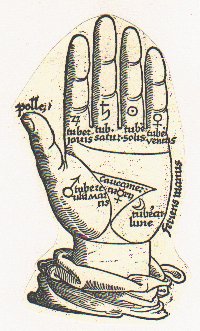
Moreover, he also allocates the planets to the mounts of the hand in a way that we have not come across before, once again confirming that by the end of the fifteenth century, no coherent system of astrological nomenclature in the hand had been generally agreed upon. Although there are some similarities with the planetary allocation that was later to become standard, here we find Venus given over to the little finger mount, Mars to the ball of the thumb and Mercury to the centre of the hand within the Great Triangle!!
The second book is in twelve chapters and goes into the meaning and significance of the main line formations of the hands, the linea vitae, linea epatis, linea cephalia, the triangle and the minor lines. Two lines he describes which we have not seen much specific mention of before as lines in themselves include the linea solis and the linea marta. Each line is treated individually and a chapter is given over to how to discriminate the responses of each of the lines to the effects of the seven planets. Finally, the last chapter of the book considers the physiognomical significance of the nails and of the hand as a whole. Despite the title of the book suggesting that there should be three books here, there is no clearly defined third section to the text. In the concluding pages of the work, Tibertus offers some general comments about the nature of chiromancy and its practice and the text ends with four illustrations of the lines and the mounts of the hands, together with their astrological rulers.
Back to Top
|
|
|