The Development of the Study of Dermatoglyphics
Towards the end of the nineteenth century, the recognition of the
importance of fingerprint patterns was gaining ground in many quarters, notably in India,
Japan, Argentina and the UK.
A British Commissioner in India, Sir William Herschel, noticed the use
of fingerprints as a form of signature amongst illiterate Indians and put this to good use
to for his employees to authenticate their identity when collecting their wage packets.
Successfully using this over a twenty year period clearly established the fact that
fingerprints did not change their form over time and that therefore they could be used as
a reliable form of personal identification.
Around the same time in Japan, a Scottish medical missionary by the
name of Henry Faulds noticed the use of fingerprints as a form of signature on pieces of
pottery and in 1880 he wrote a piece for 'Nature Magazine' suggesting that the
individuality and uniqueness of fingerprints gave them a potential usefulness in criminal
identification.
In Argentina, the Croatian Juan Vucetich had developed his own system
of identification through the use of fingerprinting and by 1891 this was being
successfully employed by the Argentinian authorities. Although it was first suggested to
the Home Office in 1887, it wasn't until 1901 that fingerprinting became an established
procedure in criminological investigation in England. This came about largely through the
efforts of Faulds and Herschel, in conjunction with Francis Galton.
Francis Galton
|
|
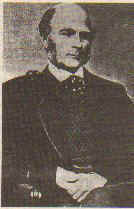
Francis Galton (1822-1911), the cousin of Sir Charles Darwin, was a
scientist with a wide range of interests covering anthropology, geology, biology, heredity
and eugenics, publishing some 240 written works, including some fifteen books. He
conducted extensive research into the significance of skin ridge patterns not only to
demonstrate their permanence and consequently their use as a means of identification, but
also to demonstrate the hereditary significance of fingerprints and to show the biological
variations of different fingerprint patterns amongst different racial groups. He collected
vast numbers of fingerprints from all types of people, noting the variations of pattern
types amongst different races and established the relative frequency |
with which each pattern type occurred amongst different peoples. His
classification of fingerprint patterns was considerably more simple than that proposed by
Purkinje, delineating only three main types of pattern. He identified the triradius as
being the significant indicator of a fingerprint pattern type and hence based his
classification on the number of triradii to be found within each pattern.
|
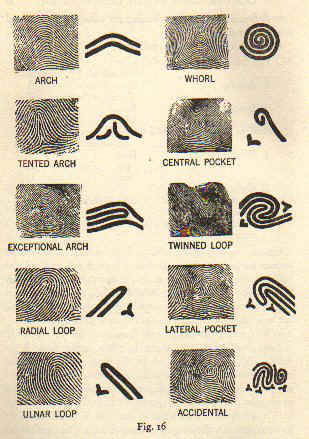
For Galton there are therefore only three main types of pattern, the
simple arch (with no triradius), the loop (with one triradius) and the whorl (with two
triradii). Although he recognises the other main patterns that can be found in the hand,
he subsumes them into this primary threefold classification. Consequently, tented arches
become a type of loop whilst double loops become a type of whorl. Whilst his system
of classification may suffice for the purposes of criminal identification, it is clear
that it leaves much to be desired in terms of discriminating the different psychological
qualities associated with each type.
Alas, it is this system of classification rather than
that of Purkinje which has been adopted by both the police and dermatoglyphicists, and
this must be borne in mind when considering fingerprint statistics from either of these
sources.
|
|
However, Galton is perhaps the single most influential figure in the
whole study of the skin ridge patterns of the hands and many of his methods for analysing
fingerprints have carried through into the work of later genetic dermatoglyphic
researches. His interest in heredity focused on the possibility of raising the standards
of physical and mental health amongst the population as a whole and he saw in the study of
fingerprints a means to initiate investigations into human genetics with this aim in mind.
To this end, in 1895 he established the Galton Laboratory for Eugenics (a term he himself
coined in 1883), at the University of London, which was later to conduct extensive
investigations into the genetic significance of the hand as well as investigating
correlations between dermatoglyphic patterns and known chromosomal abnormalities. His two
works 'Fingerprints' (1892) and 'Fingerprint Directories' (1895) are
rightly considered as classics in the field of early dermatoglyphic research and
stimulated the interest of all sorts of scientific investigators,such as anthropologists
and zoologists as well as geneticists and criminologists.
The Genetics of Dermal Ridges
After Galton's initial pioneering work, many further investigations
were undertaken to develop this fledgling science of dermatoglyphics. Anthropologists
concentrated on researching dermatoglyphic distributions of different peoples from around
the world, and work was done on clarifying both the methodology and morphology of
dermatoglyphic analysis. Meanwhile, the scientific world pioneered studies to investigate
the embryogenesis of dermatoglyphic patterns and the first studies investigating the
genetic significance of dermatoglyphic patterns were conducted. In America, HH Wilder
inaugerated investigations into comparative dermatoglyphics, producing work on both the
methodology and morphology of both palmar and plantar (feet) dermatoglyphics. H Poll and J
Dankmeijer instigated research into dermatoglyphic distributions amongst different races
and K Bonnevie investigated the embryology of dermatoglyphics as well as conducting
studies on the genetic inheritance of dermatoglyphic patterns. The scientific
investigation of the hand was beginning to prove without doubt that the hand was indeed a
study worthy of the finest minds and could reveal not only vital genetic and medical
information about an individual but also something of the psychological uniqueness of each
person. With the discovery of the significance of dermatoglyphics, the study of the hand
was truly beginning to come of age.
Fingerprints, Palms and Soles
From the mid 1930's onwards, the hand was coming to be recognised as an
important diagnostic aid in the diagnosis of congenital syndromes such as mongolism. LS
Penrose had studied the hands of people with Down's Syndrome and other conditions of
congenital mental defect for many years and had discovered that the hand revealed
particular malformations peculiar to these conditions. In 1931, he penned an article for The
Lancet correlating the absence of the medial digital crease on the little finger with
congenital mental retardation, research that proved to be but the start of a long and
detailed investigation into the relevance of the hand in the clinical diagnosis of
congenital conditions. However, the main breakthrough in establishing the significance of
the dermatoglyphic analysis of the hand came with the publication of the results of the
research of Harold Cummins and Charles Midlo in their seminal work 'Fingerprints Palms
and Soles' in 1943.
|
|
Cummins and Midlo were professors of Microscopic Anatomy at Tulane
University in the United States, and it was they who in fact coined the term
'dermatoglyphics' in 1926 (derma = skin, glyph = carving). The main thrust of their
research was into Down's Syndrome and the characteristic hand formations it produces. They
showed that the hand contained significant dermatoglyphic configurations that would assist
the identification of mongolism in the new-born child and thus they set the stage for much
of the later dermatoglyphic research work. They also researched the embryo-genesis of skin
ridge patterns and established that the fingerprint patterns actually develop in the womb
and are fully formed by the fourth foetal month. |
When it was later discovered that Down's Syndrome was in fact caused by
chromosomal abnormality, research was begun to see how far the hand could be used as a
guide to diagnosing other chromosomal defects and dermatoglyphic analysis soon became
referred to as 'the poor man's karyotype'. The researches of Cummins and Midlo had proved
that the hand could be of particular significance in the study of diseases with a genetic
origin and, given the expense involved in conducting analyses of the chromosomes
themselves, dermatoglyphic analysis was now beginning to prove itself as an extremely
useful tool for preliminary investigations into conditions with a suspected genetic basis.
Genetic and Chromosomal Research
It was reading Cummins and Midlo's work that inspired LS Penrose to
conduct his own dermatoglyphic investigations as a further aspect of his research into
Down's Syndrome and other congenital medical disorders. In 1945, he was appointed to the
Galton Chair of Eugenics at London University. Although the post had existed for some
fifty years up to this point, very little research had actually been done into the genetic
significance of fingerprints. Penrose was about to change all of that. Whilst he held the
post, he conducted extensive investigations into chromosomal disorders and their
dermatoglyphic manifestations, considering not only the more common trisomies such as
Down's Syndrome, Edwards Syndrome and Patau's Syndrome, but also initiating investigations
into other more rare chromosomal disorders such as 'Cri du Chat' Syndrome, and the sex
chromosome disorders, Turner's Syndrome and Kleinefelter's Syndrome.
Characteristic Palmar Features in Down's Syndrome
Cheiromorphognomy:
- short, broad palms with short fingers
- short Air fingers (55% cases) (normally only found in 5% hands)
- clinodactyly of Air finger (55% of cases) (normally only found in 6% of hands)
- single interphalangeal crease on Air finger (26%) (virtually never seen normally)
- hyperflexive lower thumb joint (77%) (normally only found in 28% of hands)
- Simian lines commonly present (53%) (normally only found in 1-2% of hands) |
|
The dermatoglyphic features commonly seen in the hands of those with
Down's Syndrome include:
- increased incidence of ulna loops (83%) (normally 63%)
- ulna loops very high and L shaped
- often have 10 ulna loops (35%) (normally only 5%)
- reduced incidence of whorls (12%) and arches (3%)
- decreased incidence of radial loops but increased incidence of radial loops on fingers
other than Water finger (Fire/Air fingers normally virtually never have radial
loops)
- displaced axial triradius to t2 position, occuring on 85% DS hands (4% in controls)
- large dermatoglyphic patterns in hypothenar area of the hand in 80% of DS hands
- Interdigital Loop I3 very common occuring on 90% DS hands (only 40% normally)
- transverse alignment of skin ridges in Interdigital area
- low a-b ridge count
- increased incidence of skin ridge dissociation
The Kennedy-Galton Centre
In 1965, the Galton Laboratory became the Kennedy-Galton Centre for
Clinical Genetics and Mental Deficiency Research under the chairmanship of Penrose. A new
centre was set up in Hertfordshire as a research facility especially dedicated to
chromosomal and dermatoglyphic research as well as a facility for offering genetic
counselling for prospective parents. Penrose also contributed to the development of
dermatoglyphics in that he established several important methodological procedures and
practices. It was he that formulated the measurement to establish the position of the
displaced axial triradius in terms of the ATD angle, as well as establishing the
inheritance of its position in the palm. In 1967, he chaired an International Symposium
convened to standardise dermatoglyphic nomenclature and terminology.
One of Penrose's assistants at the Kennedy-Galton centre was Sarah
Holt, whose own work 'The Genetics of Dermal Ridges' published in 1968,
summarises much of both her findings and the research of the centre itself. Much research
was done on establishing the statistical distributions of dermatoglyphic patterns of both
the fingers and the palm in various peoples, both normal and congenitally afflicted. In
addition to giving further confirmation of the genetic and chromosomal basis of
dermatoglyphic patterns and investigating the manifestations of these in Down's Syndrome
and other chromosomal disorders, other investigations focused on which dermatoglyphic
features are in fact inherited and how inheritance might be detected. This research
focused particularly on the identification of those features of the palm which would
indicate the genetic likelihood of a mother giving birth to a Down's Syndrome child, but
also concentrated on the study of twins and especially identical twins, given their
genetic identity. Through these researches it has now been established that it is possible
to ascertain whether a pair of same-sex twins are monozygotic or dizygotic (ie fraternal
or identical twins) from an examination of their fingerprints alone!
Dermatoglyphics Today
Although many important discoveries regarding the psychological
significance of fingerprint patterns have been made, the main thrust of scientific
dermatoglyphic research in the latter half of the twentieth century has been directed into
genetic research and the diagnosis of chromosomal defects. Over the last thirty years or
so, more than four thousand papers have been written on the significance of
skin-ridge patterns! Whilst many of these have been restricted to the study of genetic or
congenital disorders, not all of them have been concerned solely with chromosomal
disorders. Significant investigations have also been carried out into the dermatoglyphic
indicators of congenital heart disease, leukaemia, cancer, coeliac disease, intestinal
disorders, rubella embryopathy, Alzheimer's disease, schizophrenia as well as other forms
of mental illness. Most of this research has only been published in the pages of medical
journals, but a good summary of these findings can be found in Schaumann and Alter's 'Dermatoglyphics
in Medical Disorders' published in 1976.
The current state of medical dermatoglyphics is such that the diagnosis
of some illnesses can now be done on the basis of dermatoglyphic analysis alone and
currently, several dermatoglyphic researchers claim a very high degree of accuracy in
their prognostic ability from the hand's features. Dr Stowens, Chief of Pathology at St
Luke's hospital in New York, claims to be able to diagnose schizophrenia and leukaemia
with up to a 90% accuracy from the patterns of the hands alone and in Germany, Dr
Alexander Rodewald reports he can pinpoint many congenital abnormalities with a 90%
accuracy from a consideration of the features of the hands alone.
In fact, in Germany dermatoglyphic assessment has been taken very
seriously indeed, to the extent that computer programmes have now been designed to perform
rapid multi-variate assessments of hand imprints which can predict with up to an 80%
accuracy the chances of a new-born child developing heart disease, cancer, leukaemia,
diabetes or mental illness. Such is the status of dermatoglyphic analysis in Germany, that
it has become an integral part of the medical syllabus in many German universities and it
would seem that before too long, the diagnosis of disease from the patterns of the hand
will become a quite ordinary and commonplace activity.
The modern study of the hand is thus far removed from the popular image
of the soothsaying hand reader uttering mysterious incantations in an arcane language.
Rather, through decades of scientific research, the hand has come to be recognised as a
powerful tool in the diagnosis of psychological, medical and genetic conditions. For
dermatoglyphic research and the discoveries of medical science have corroborated many of
the traditional claims of hand analysts and has provided a firm empirical basis for the
modern study of chirology.