Other Seventeenth Century Works on Hands
The Hand in Gesticulation
One early seventeenth century work on the significance of the hand is
to be found in the writings of John Bulwer a physician from London who is thought to have
been a palmist as he often went under the title of 'The Chirosopher'. However, his two
works encompass nothing of the art of chiromancy and instead concern themselves more with
the meaning and significance of hand gestures. His 'Chirologia, naturell language of
the Hand' of 1644 observes the important role our hands play in the act of
communication and, indeed, that gestures themselves have a language all their own.
The bulk of the book consists of illustrations of various gestures and
hand positions, together with short explanations on their meanings. The second section
specifically considers the use of the hands in oratory and public speaking, where he
rightly observes that the natural gestures of the hands are "an adjunct to rhetorical
utterance". His second work 'Philocophus' of 1648 is a supplementary work to
the first, and although it is subtitled 'The Deaf and Dumb Man's Friend', it is not a book
on the specific use of the hands as a sign language as it might at first seem. Rather,
Bulwer is merely keen to point out that we can and do communicate very clearly with our
hands; even if we are deaf and mute, we can still convey ideas through the postures and
expressions of our hands.
Although such studies are ancillary to the usual concerns of both
chiromancers and chirologists, nevertheless Bulwer's work has been mirrored in more recent
years by the studies of hand gestures in the mentally ill, as conducted by Charlotte
Wolff. All these researches lend some considerable support to the basic premise of all
hand analysts, that the hand is the expression of the consciousness of its owner.
The Puzzle of a Curious Fish
Two chapters on chiromancy can be found in a work entitled 'Polygraphice' by William Salmon (1664-1713), published in London in 1675. The work has actually very
little to do with hands, or any of the other divinatory sciences for that matter, and it
is puzzling why Salmon should have wished to reproduce a work on chiromancy in a text
which is written for artists and is primarily concerned with the art of drawing! William
Salmon was a widely read and extremely learned man, as is shown by the catalogue of the
contents of his library which went up for auction shortly after his death in 1713. Many of
the works listed here are titles in French, Greek, Latin and even Hebrew. He was primarily
a doctor of physic and chirurgery (surgery) but had many diverse interests including
chemistry, mathematics, history and theology, as well as a practical eye for the art of
drawing.
The 'Polygraphice' is a work is in four parts, a book on drawing, a
book on engraving and etching, a book on painting and a book on the 'Perfection of the
Arts'. The two treatises on chiromancy are to be found at the end of book one (p46-50) and
at the end of book four (p389-407). The first is an introduction to chiromancy entitled 'A
Rational Demonstration of Chiromantical Signatures', and covers basic principles and
outlines the names and locations of the different features of the hands. This is the
original work, as we shall see shortly.
The second treatise is concerned with the interpretation of the palmar
lines and the various lineal markings. A short section is given over to each of the main
lines of the hands and their corresponding mounts and in reading the text, one is
immediately struck by the similarity between this work and the 'Cheiromantia' of
Johannes Rothmann. In fact, it would seem that this second text is quite simply a copy of
either Rothmann's original work or George Wharton's translation of Rothmann, for the bulk
of the text of this second treatise is absolutely identical with the first part of
Rothmann's book! Nevertheless, there has been some judicious editing and rearrangement of
the text - the sections on the lesser lines and their mounts have been put together, for
example - plus a few minor amendments in the wording of the text itself. Whilst it is
possible that this is a more original translation from Rothmann's work, it seems more
likely that this is simply a re-presentation of Wharton's translation. This is amply
confirmed by the illustration of the hand given in the first chapter which is virtually
identical to the frontispiece in Rothmann's work, complete with quotation from Job 37:7!
However, the text does not include any of the astrological charts with their chiromantic
comparisons and in this way can be seen to be somewhat inferior to the original.
This is not to say that William Salmon is nothing but a
copyist. Whilst the second treatise is more or less is simply a reproduction of the
interpretative part of Rothmann's work, the first of these two treatisesSalmon's has
nothing in common with the introductory section in Rothmann at all. Here we find some
quite different and quite unusual approaches to the hand. The description of the lines,
the mounts and the meanings of the planets all seem to be quite original and the format in
which this is presented is different from other contemporary texts. The descriptions given
show that Salmon is indeed familiar with the rudiments of the chiromantic art after all
and understands the astrological significance of the planets at least, even if he does not
want to follow Rothmann's attempt at demonstrating the concordance between chiromancy and
astrology. However, he does deviate a little from the chiromantic norms of the day,
and refers to the lifeline as the linea Jovialis and the Mensal line as the
linea stellata. Given the lack of any originality in the interpretative section on
the lines, we should see perhaps these more as an error rather than as an innovation,
particularly since he does not use these terms in the interpretative text itself.
From such observations as these, we can see that it is doubtful that
Salmon had anything more than just a passing interest in chiromancy and that it is
unlikely he was a chiromancer in his own right. It just remains for someone to discover
why on earth he decided to include two chapters on chiromancy "Added by way of an
Appendix" in a work which is primarily a practical working manual for artists!
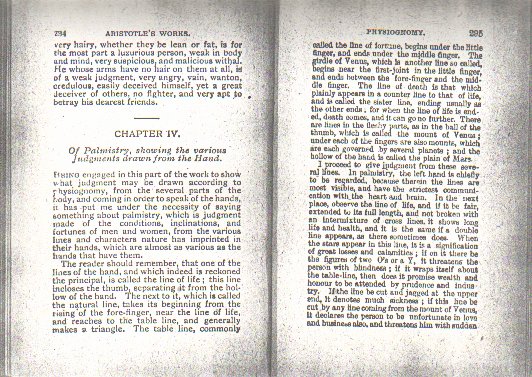
Aristotle's Posthumous Masterpiece
One other curious text published sometime in the late seventeenth
century, perhaps c.1684, which also includes a chapter on chiromancy is an anonymous work
entitled 'Aristotles Masterpiece', purporting to be an original work of Aristotle himself
and reprinted as such by Benham in his 'Laws of Scientific Handreading' of 1900.
However, even a cursory glance at the contents and themes of the text reveals that this is
quite obviously not the case! The short chapter on palmistry, in the section on
physiognomy, covers the various locations and significances of the lines of the hand,
especially the markings indicative of health and illness, virtue and honour, husbands and
children, fortune and death etc, all the themes with which we are now entirely familiar.
However, the garbled form in which some of the lines and their markings are described and
some confusion over the terms used suggests the author was not very well versed in his
craft - he is unclear about the location of the Middle or Natural line, for instance, and
suggests that it is the letter Y in the lifeline that signifies loss of one's eyes and
blindness. Indeed, the contents of this work demonstrate something of a precipitous
decline in chiromantic understanding, compared to the sophistication of other contemporary
authors.
One thing we can be certain of though, this is quite definitely not an
authentic work by Aristotle! Besides the fact that it goes into the markings of the hand
in considerably more detail than anything we know Aristotle to have written, the
astrological language in which it is written and the themes which it covers clearly reveal
that the author of this work definitely lived sometime after 1500AD!
Back to Top