
|
|
|
|
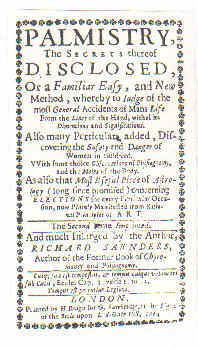
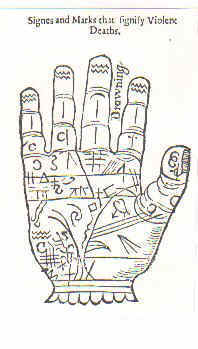
However, one is not long in reading this work when one begins to realise that much of this supposed greatness is due almost entirely to Jean Belot. For although Belot is not mentioned in the commendation from Lilly and is unacknowledged by Saunders in his preface, it is perfectly clear that this work is almost an exact copy of Belot's 'Les Oeuvres' in translation. The first part of the book is the chiromancy over 136 pages - the first 81 of these being taken shamelessly from the pages of Jean Belot. He even reproduces an exact copy (in translation) of Belot's famous diagram of the hand with the zodiacal signs on the finger phalanges! The only section Saunders leaves out is how to know your genie/guardian angel from the hand. Moreover, Saunders also copies Belot for the physiognomy... and the section on the interpretation of dreams.... and the section on the Lullian Art of artificial memory. In fact this whole book is a copy of Jean Belot, with only a few ideas and diagrams added by Saunders. The one section that is entirely different is not even about hands - it is a treatise on divination from the location of moles. The only part of the chiromancy which can be seen to be Saunders' is the section of illustrations and aphorisms that follows the theoretical part of the text. Here he gives 47 diagrams of hands marked with various lineal inscriptions, with 700 aphorisms carefully numbered against them to give their interpretation. These consist of the traditional 'sign and symbol' approach and cover all the usual themes and superstitions, quite against the relative sophistication of the astrological theory that precedes it. And many of the interpretations are simply the same old chiromantic lore that we first saw centuries ago! Where is there something new, innovative and inspired from one deemed by so many to be one of the 'greats' of handreading history..... Saunders and the Planets One innovation that Saunders does make, is to give planetary rulers to the main lines of the hand. The life line is given to the sun, the head line to Mercury, the Heart/Table line to Jupiter, the Girdle of Venus to Venus and the line of death to Saturn, one of the first attempts to make a clear astrological association to the lines of the hands. However, it is less clear as whether Saunders actually used these designations in his interpretations of the lines of the hands. Like Belot, his chiromancy is very astrological - indeed, Saunders was something of an astrologer himself and included a treatise on electional astrology in one of his later works. However, in other respects, Saunders simply follows Belot in astrological assertions. Like Belot, he looks for 'sacred letters' in the lines, and each letter is considered in detail according to where it might be found. For instance, a T on the back of the thumb is given to be an indication of sodomy and bestiality whereas an S in the plain of Mars signifies victories and honour in war. Saunders even includes the section on how one might know the day of birth from the lines of the hand; if one's head line ends on the mount of the moon with a cross, then this shows you were born on the tenth day of June on a Monday... but if it ends there with two crosses, then you were born on the twentieth day of June, on a Monday!! (work it out.... and see you at the bottom of the page if it eludes you...!) Palmistry's Secrets
The main part of the book consists of diagrams of hands with many markings, grouped together under various headings as if the text were designed as a handy work for quick referencing. Sections include all the known chiromantical markings of Violent Deaths, Riches and Fortune, Poverty and Loss, Misfortune and Imprisonment, Length/Brevity of life and marks that signify Sex, Lust, Whoredom and Easy or Difficult Childbirth. At one point in this text, Saunders makes a list of the qualities he thinks are necessary for one to become a good chiromancer. In addition to having a good memory and being a good observer he suggests that one should also be a good philosopher, astrologer, mathematician and linguist and have a good knowledge of such things as history, geography and religious customs. He also suggests that one should be 'prudent, discreet, honest and esteem the truth in all things..' We have seen that he is both a good linguist and is intensely discreet; it is a shame he has proven himself to lack honesty and esteem for the truth in all things. Physician, heal thyself, we cry! The English Fortune Teller A further treatise on palmistry thought to be written by Saunders can also be found as a short chapter included in a work entitled 'The English Fortune Teller', published sometime around 1680. This the most populist of all his writings, which is unsurprising given that the book as a whole is a general work on the art of civility and courtship. Titles included within the book include 'The Maiden's Faithful Counsellor or, the Speediest Way to get Good Husbands', 'Cupids Soliciter of Love' and 'The New Way of Wooing'! Sixteen pages on divination are included, from the hand, from moles and from dreams, written especially for wives, widows, maids and bachelors. Although the text is relatively short, Saunders has clearly picked out those chiromantical aphorisms from his larger works which he knows will be of especial interest to this particular audience. For instance:
Saunders does not dwell only on markings of fortune, riches and honour, wives, husbands and children however, for he also includes those salient lineal indicators of poverty and losses, of length of life and untimely death. All in all a little potboiler for the interest and titillation of the amorous and over-sexed!
There is a further page on chiromancy also to be found in this book entitled, 'Palmistry Displayed', giving eight further chiromantic aphorisms in amongst some remarks on the interpretation of moles and dreams. Although the author of this little tract is anonymous, it was originally included in a pamphlet entitled 'The Court of Curiosities and the Cabinet of Rarities' published in c.1680. Saunders also wrote works on astrological judgement and even a text on the practice of physick, for whilst he was the foremost English chiromancer of this period, he was also an accomplished and respected astrologer. Due to the fact that Lilly, Saunders and Wharton were all at one time or another based in Oxford and due to the fact that Ashmole maintained close links with Oxford University, much of the original material by this close circle has found its way into the vaults of the Bodleian Library, including the personal copies of texts owned by Lilly and Ashmole themselves. However, the demise in interest in the occult sciences has meant that much of it has remained untouched and unexamined for over three hundred years. For the latter end of the seventeenth century was to prove to be the last 'golden age' in the study of the mystical sciences, the final culmination of a world view that had predominated for over four hundred years.
|
|
|